Inventory History Report
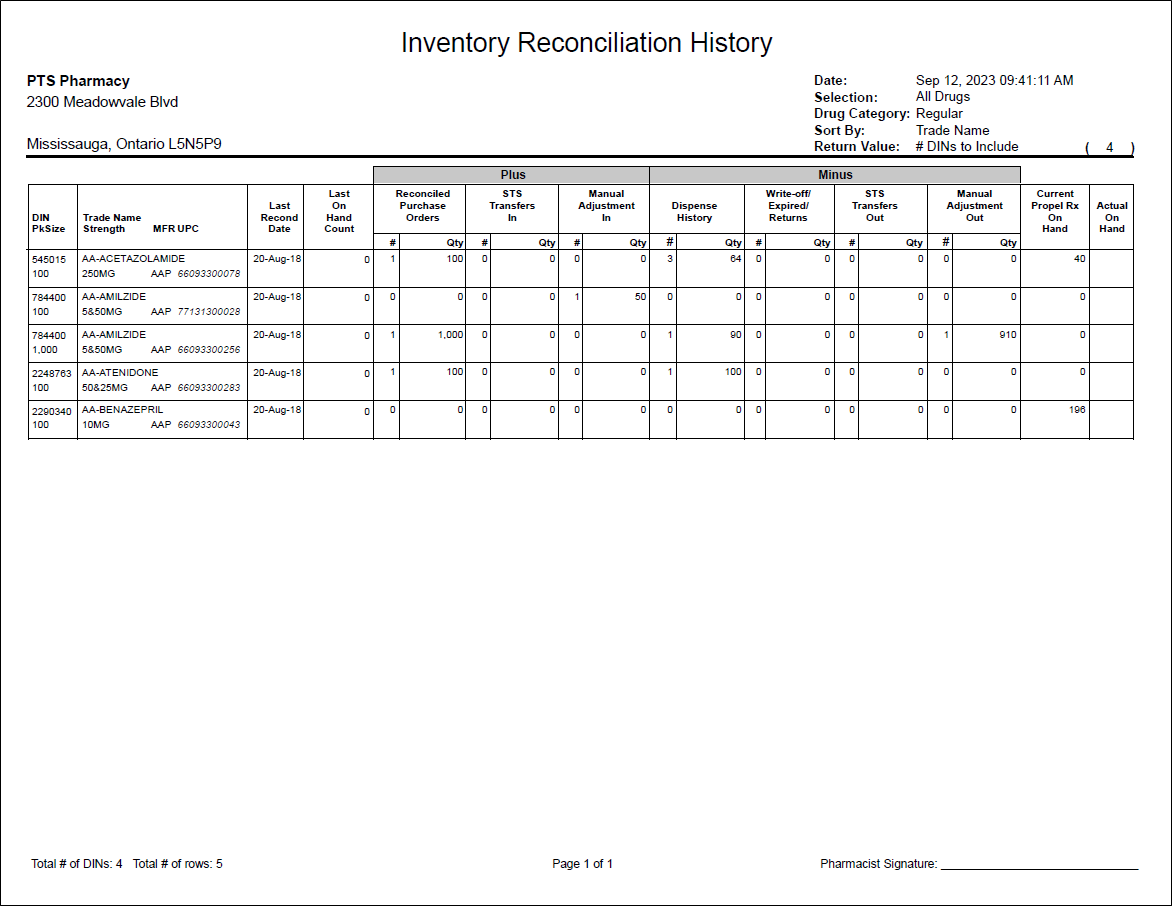
The Inventory History report can be used to perform routine cycle counts by generating a list of DINs to perform physical counts for. The report can be used in combination with the Cycle Count module to update Actual on Hand values.
The report excludes drugs flagged as PFS or POS Product and mixtures.
There are two parts to complete when using the Inventory History report:
Part 1: Run the Inventory History Report
To run the Inventory History report:
-
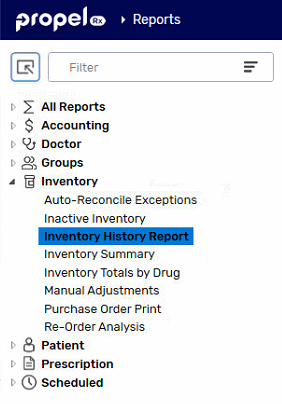
From the Workbench, select More (...) > Reports > Propel Rx Reports. The Reports window appears.
-
Select Inventory > Inventory History Report..
-
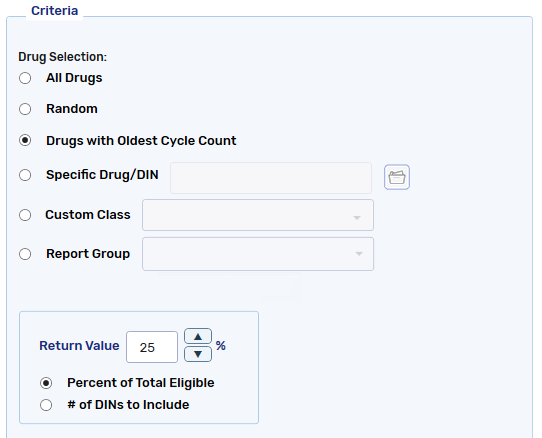
In the Criteria section, select one of the following options:
Some fields in the Criteria and Extended sections may be disabled based on your selections, as certain options cannot be used together.
-
Drug Selection
- All Drugs - drugs that have an Actual on Hand value, a balance owing or had movement since the last cycle count.
-
Random - drugs that have an Actual on Hand value, a balance owing, or had movement since the last cycle count and have not been cycle counted in the last 30 days.
-
Drugs with Oldest Cycle Count - generates the report for drugs with no cycle count date followed by the oldest cycle count date.
-
Specific Drug/DIN - multiple drugs can be entered and separated by a forward slash (/).
-
Custom Class - generates the report for drugs with the specified custom class.
-
Report Group - generates the report for the selected report group(s). Only report groups that have a type of Drug/Mixture are available for selection. If more than one is selected, drugs or mixtures that belong to at least one of the report groups and meet the other selected criteria will display on the report.
-
Return Value
-
Percent of Total Eligible - generates the report for the specified percentage of eligible drugs according to the Extended criteria. The default percentage is 25%.
-
# DINs to Include - generates the report for the specified number of eligible drugs according to the extended criteria. The default value is 10.
This option is not available if a specific drug or DIN is selected.
-
-
-
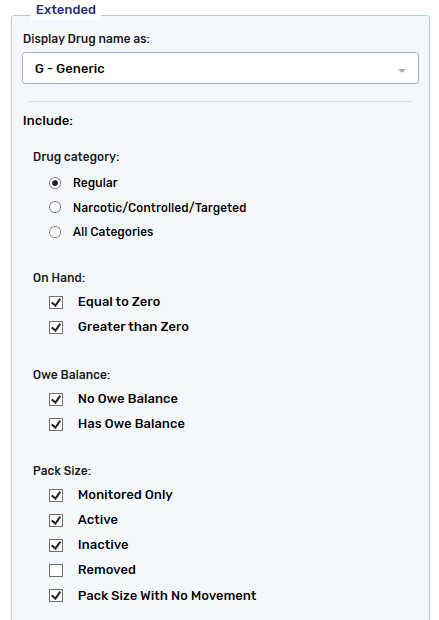
In the Extended section, select one of the following options:
-
Display Drug Name As - determines how the drug name displays on the report. Options include G - Generic and T - Trade.
-
Drug Category
-
Regular - generates the report for regular drugs.
-
Narcotic/Controlled/Targeted - generates the report for narcotic drugs, controlled drugs, or targeted substances.
-
All Categories - generates the report for regular and narcotic/controlled/targeted drugs.
This option is not available if a specific drug or DIN is selected.
-
-
On Hand - one or more checkboxes can be selected. If all or no checkboxes are selected, Propel Rx will generate the report regardless of on hand value.
-
Equal to Zero - generates the report for pack sizes with no on hand amount.
-
Greater than Zero - generates the report for pack sizes with on hand greater than 0.
-
-
Owe Balance - one or more checkboxes can be selected. If all or no checkboxes are selected, Propel Rx will generate the report regardless of owe balance value.
-
No Owe Balance - generates the report for pack sizes that do not have owe balances.
-
Has Owe Balance - generates the report for pack sizes that have owe balances.
-
-
Pack Size - one or more checkboxes can be selected. If all or no checkboxes are selected, Propel Rx will generate the report for monitored pack sizes regardless of status (monitored, active, inactive, removed) or movement.
-
Monitored Only - generates the report for pack sizes that are monitored. If this checkbox is deselected, the report is generated for all pack sizes, regardless of monitoring status.
-
Active - generates the report for active pack sizes (i.e., Active flag is on).
-
Inactive - generates the report for inactive pack sizes (i.e., Active flag is off).
-
Removed - includes pack sizes that have been removed from Propel Rx on the report.
-
Pack size with no movement - if selected, includes pack sizes with or without movement during the report period. If deselected, only pack sizes with movement during the report period are included.
-
-
-
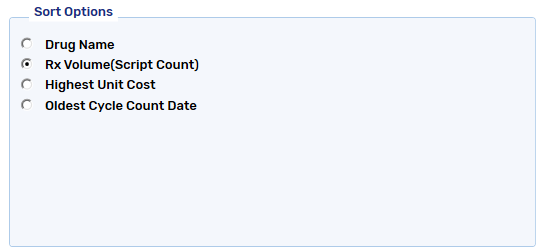
In the Sort Options section, select one of the following:
-
Drug Name - sorts the drugs on the report alphabetically in ascending order by the drug name, as specified in the Display Drug Name As field.
-
Rx Volume (Script Count) - sorts the drugs on the report by prescription volume in descending order.
-
Highest Unit Cost - sorts the drugs on the report from highest to lowest acquisition cost.
-
Oldest Cycle Count Date - sorts the drugs on the report from the oldest to most recent last cycle count date.
-
-
Select Print. The Inventory History report is generated and prints.
-
Proceed to Part 2: Use the Cycle Count Module.
Part 2: Use the Cycle Count Module
To use the Cycle Count module after generating the Inventory History report:
-
From the Workbench, select More (...) > Inventory > Cycle Count. The Cycle Count module opens.
-
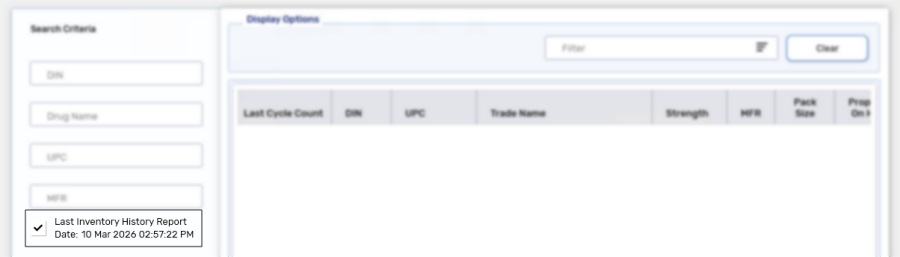
In the Search Criteria section, select the Last Inventory History Report checkbox.
-
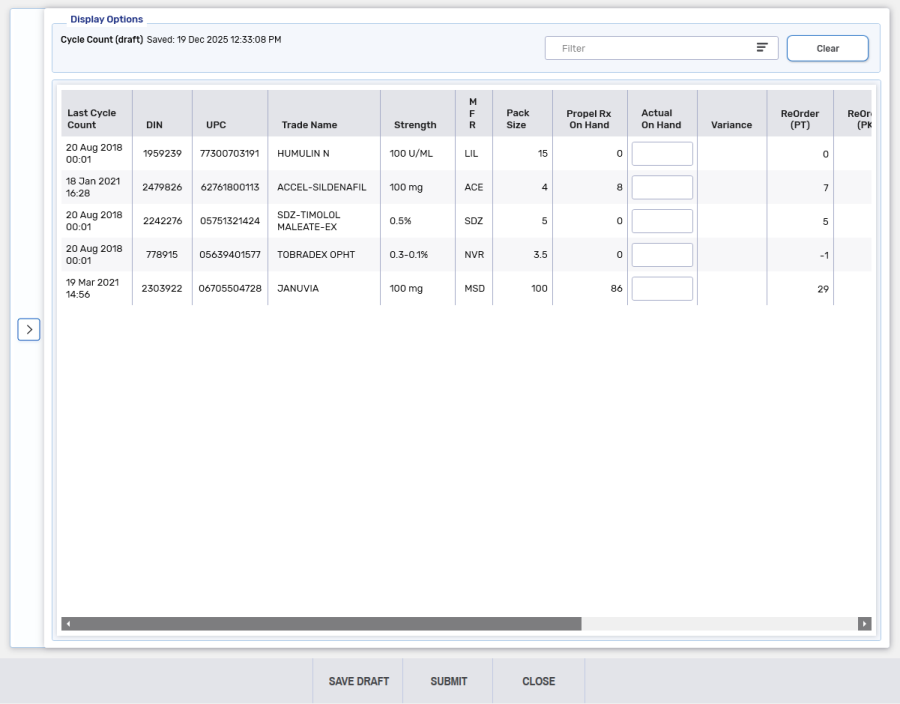
Select Search. The Search Criteria will collapse and results that match the search criteria display.
If a product has not been cycle counted before, it will show a Last Cycle Count date of August 20, 2018, which corresponds to when the Cycle Count module was first introduced in Propel Rx.
-
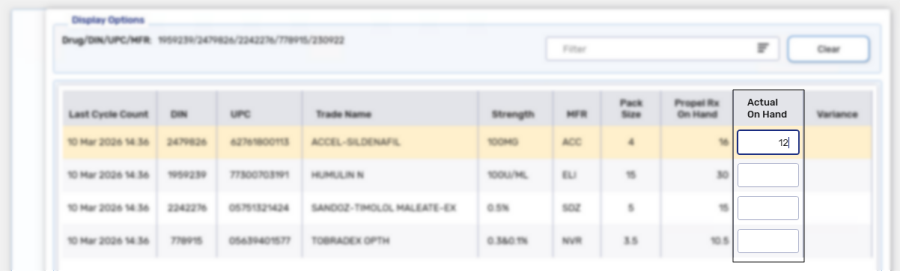
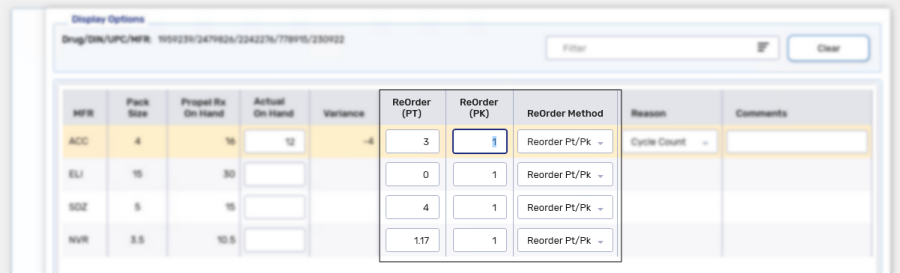
In the Actual on Hand field, enter the physical count of the drug.
-
The ReOrder Method is enabled and can be edited, if required. Options include:
-
Reorder Pt/Pk - turns the Monitor flag ON (if not already) and enables the ReOrder (PT) and ReOrder (PK) fields. Edit the ReOrder (PT) and ReOrder (PK) fields if needed.
-
Do Not Reorder - ReOrder (PT) and ReOrder (PK) fields are disabled.
 ReOrder Method is disabled
If the product is part of an order group but is not the default pack size for the group, the ReOrder Method field will be disabled. From the Cycle Count module, you can only update the reorder method for the default pack size.
-
-
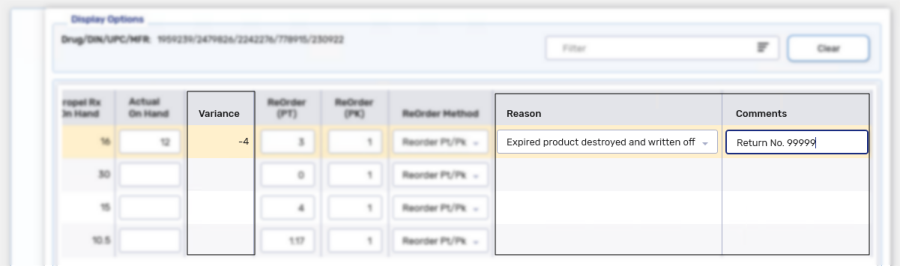
If the Variance is negative, the following information must be entered:
-
Reason - select the appropriate reason from the dropdown. By default, this is set to "Cycle Count." If the reason is unknown, you may select "Investigated. Cause of Variance Unknown."
-
Comments - add information pertaining to specific reasons (e.g., prescription numbers or return reference numbers).
You can sort the Variance column by selecting the column header. This allows drugs with the highest variance to be displayed at the top for investigative purposes.
-
-
Select Submit.
If there are blank Actual on Hand values, when submitted they have a Reason of NOT COUNTED.
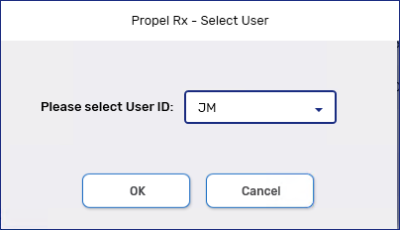
A prompt displays.
-
Select the pharmacist's initials from the dropdown.
-
Select OK. A confirmation window displays to show that the cycle count was successful.
-
Select Print to print the Cycle Count Summary report.
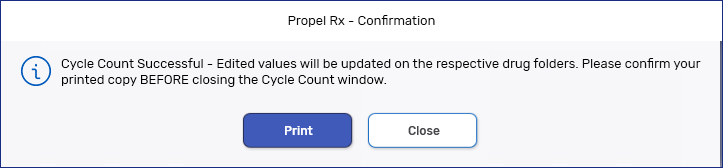
Confirm the Cycle Count Summary report successfully printed. If not, select Print again as the report cannot be retrieved once it is closed.
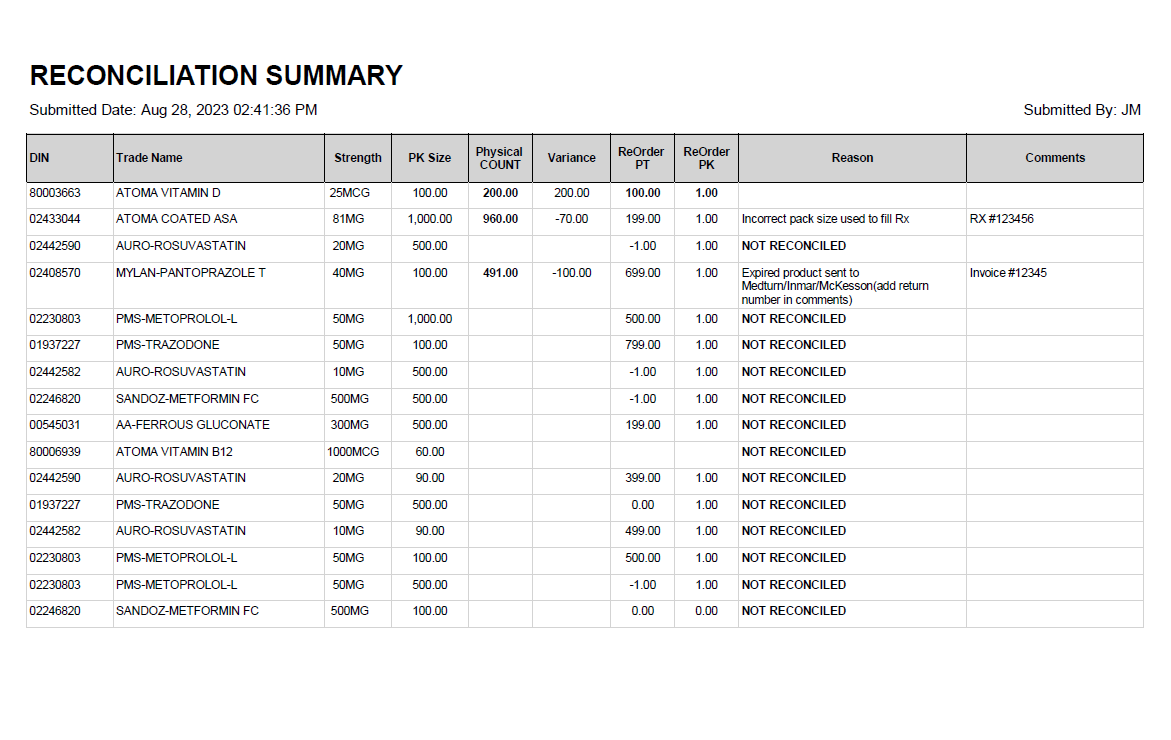
Once a cycle count is submitted:
-
The Actual on Hand, ReOrder Method, Re-Order Point and Re-Order # Packs fields are updated in the Drug Folder.
-
An entry is written to the Shipment Details window and the Drug Folder History tab.